|
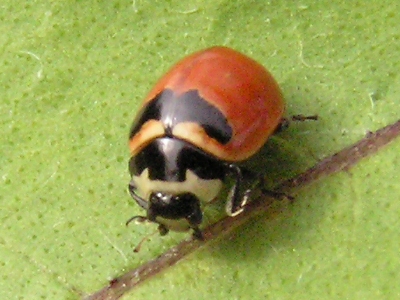
Three-banded Lady Beetle
( Coccinella trifasciata subversa ) |
|
 |
|
| 2004-0128-01100137-COL00341-Coccinella_trifasciata_subversa[1303h03s,F,A,plant-leaf]{EXD}-G.jpg |


|
|
| IDENTIFICATION |
| Identification: | Coccinella trifasciata subversa
(LeConte, 1854)
|
| Common Name: | Three-banded Lady Beetle |
| Life Stage: | A |
|
| PHYLOGENY |
|
| Phylum: | Arthropoda |
| Class: | Insecta |
| Superorder: | Holometabola |
| Order: | Coleoptera |
| Suborder: | Polyphaga |
| Family: | Coccinellidae |
| Subfamily: | Coccinellinae |
| Genus: | Coccinella |
| Taxon Code: | COL00341 |
| ITIS TSN#: | 692668 |
LOCATION DETAILS
|
| Location |
|
|
| ECI Site#: | CA01100137 |
RECOGNITION
|
| Adult: Elytra are red with a single, dark basal band. The pronotum is black with a white anterior margin and a pale ventral spot. Larva: Pale yellow with small dark spots, notably paler than the larvae of other ladybirds. |
| Body Length |
| 4-5 mm. |
| Similar Taxa |
| Similar to C. t. perplexa, but uslaly have the transverse bands reduced, interrupted or absent. |
BIOLOGY
|
| Food |
| Aphids and other soft-bodied insects. |
| Habitat |
| Found on grasses, weeds, succulents and crops that host aphids in meadows, weeds, gardens and agricultural fields. |
| Active Period |
| Active from spring through summer months and on warm days of fall; diapausing through the colder winter months. |
| Development |
| Females lay a cluster of small, pale yellow football shaped eggs, usually in the spring and summer. Eggs are glued to the underside of a leaf where there are abundant aphids, and sometimes on other substrates. Eggs hatch in about a week. Emerging larvae resemble tiny dark alligators. There are four instars before pupation. Mature larvae anchor to plants or other substrates. Pupation lasts from a few days to more than a week. |
| Range |
| California, north to British Columbia. |
| Distribution |
| The west coast of North America |
HABITAT
|
| Found on grasses, weeds, succulents and crops that host aphids in meadows, weeds, gardens and agricultural fields. |
CREDITS
|
Photographer
Eddie Dunbar |
REFERENCES
|
- Subspecies Coccinella trifasciata subversa. (http://bugguide.net/node/view/98692). Accessed February 1, 2016. [ IMAGES ]
- Integrated Taxonomic Information System TSN#692668
- The Coccinellidae (Coleoptera) of America North of Mexico. Robert D. Gordon (1985), from the Journal of the New York Entomological Society.
- Subspecies Coccinella trifasciata subversa. (http://bugguide.net/node/view/98692). Accessed February 1, 2016.
|
|

